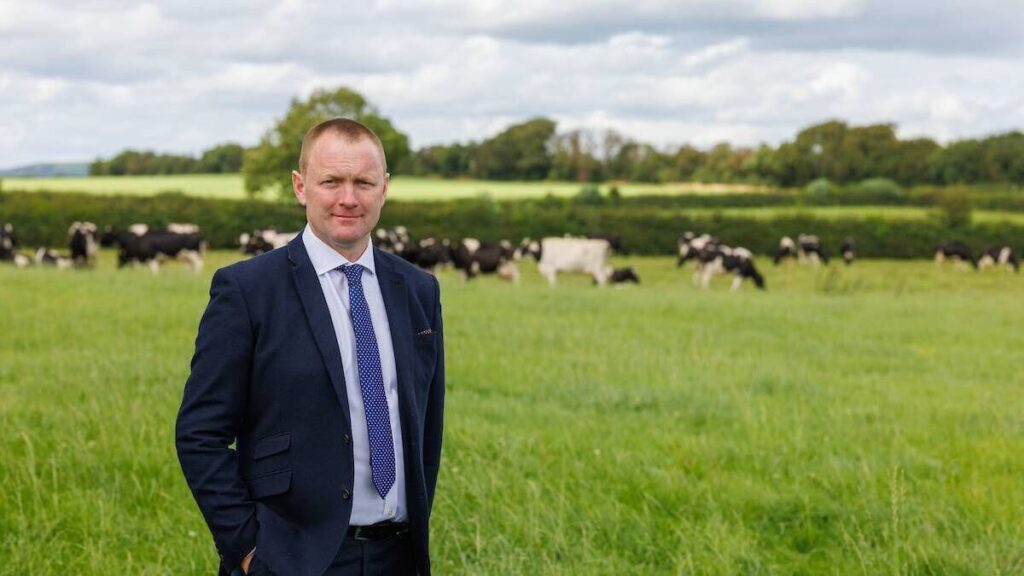
Denis Drennan: Is a farmer someone who just owns farmland or someone who produces food?
First published in the Irish Examiner on 10 September 2026. Reproduced with permission.
Original article: https://www.irishexaminer.com/farming/arid-41909113.html
CAP funds are misdirected from active food producers to landowners.
A ‘starter’ question for five marks: What is a farmer? Have you got an answer? How about a follow-up question for €10bn (the total of national and EU funds distributed per annum under the present CAP): what’s an ‘active farmer’?
ICMSA assumes that it’s not a question that will keep the non-farmers awake at night. But it’s one that deserves some attention and most certainly is going to demand an answer over the next year or so. Put as bluntly as this kind of outlay demands, ICMSA is convinced that CAP, and the direct supports paid out under its remit, must be re-oriented and directed towards those farmers who produce food for general consumption.
We have become convinced – and the evidence is now pouring in to support us – that hugely excessive amounts of CAP direct payments are now going to effectively individuals who have relegated the production of food to that of an afterthought. What was originally designed as a support to food producers is now functioning as a ‘blanket’ payment to landowners, whether they engage to any degree in meaningful production of food.
CAP was ‘decoupled’ from food production in 2003, and the direct supports available gradually began to fall on ownership of the eligible land. For a variety of reasons – chief amongst them, the increasingly alarming trend of high net worth non-farmers using farm succession tax measures to pass on wealth through the purchase of farmland – we are now left contemplating a situation where not alone are active food-producing farmers finding themselves repeatedly outbid for necessary adjoining land by wealthy non-farming concerns, but these same non-farmers have the pleasant surprise of finding themselves in receipt of the direct supports for which they now qualify by virtue of owning the eligible land and stocking it with a few animals or no animals at all.
A few months ago, ICMSA advanced our definition of what we believe constitutes an ‘Active Farmer’. We think that the most practical way of defining that must be via stocking rates, and we have deliberately advanced a definition that has an active farmer as someone with a stocking rate of at least 1 Livestock Unit per Hectare. It’s fair to say that our definition has not been met with universal welcome, but we are seeing growing support for it. The only precondition we would ask people to consider before they contribute to that debate is that they go back and see who and what CAP was set up for.
If everything is a journey – and God knows CAP certainly has been – then it’s surely vital to know where the journey started and for what purpose.
CAP was designed to bridge the gap between what the populations of the great European cities wanted to pay for their food and what the producers of that food, the farmers, needed to keep farming and producing that food. In the decades after 1945, there was massive migration to the ruined cities that needed to be rebuilt, and there was a recognition on the part of individual governments and the early EEC that getting adequate amounts of food into those cities at affordable prices was the indispensable element. CAP was invented to establish food security and to bridge the gap between the ‘Cheap Food’ policy at retail level and the real costs of producing that food and keeping sufficient farmers on the land to keep the food going into the cities.
That’s not a matter of opinion or interpretation; it’s a matter of historical record.
For just so long as that original purpose and understanding were accepted and acted on, CAP functioned. The problems began – and again, this is a matter of record – when the EU decided that the handiest way of introducing Environmental, Biodiversity and Sustainability targets and restrictions was via CAP. What followed – and is still ongoing – was clumsy ‘bolt-on’ and policy ‘retrofitting’ of these ‘Green’ ambitions that effectively cancelled out the original purpose and mechanism. Effectively, CAP was repurposed to try and do two jobs instead of the one it was originally designed for – supporting food-producing farmers – and it is now failing on both: the original one of supporting food-producing farmers and enabling high-quality food at affordable prices and the ‘bolted-on’ one of attaining emissions-lowering Environmental, Biodiversity and Sustainability targets.
The bitter irony here is that the Green lobby would argue that it isn’t working for them either and they, too, see that CAP is ‘falling between two stools’: support for food production and attaining Environmental targets. It isn’t fulfilling either function and is falling short on both. The gap between these two aims has proved to be the entry point for the smart accountants and investment managers looking for ways to minimise their clients’ exposure to inheritance taxes.
CAP was designed to support the farmers producing the food that fed those original urban and suburban populations. That was its original purpose, and that is still the purpose for which it is most suitable. In fact – and in light of the highly combustible and uncertain international political situation – we might need to ‘double-down’ on our own internal EU capacity to feed ourselves.
The time for ‘humming and hawing’ around these issues is gone. ICMSA does not believe in attempting to make CAP a dual-purpose strategy and we maintain that CAP must revert to being a fund that supports food producers through meaningful direct payments and if the EU wants to support people to achieve Environmental aims and ambitions, then they should introduce a CEP – a Common Environmental Policy – and fund that separately.
The idea that someone with land is a ‘farmer’ in the same sense that someone milking a herd of cows twice daily and ‘back boning’ a hugely valuable food resource and export is a fiction. It’s always been a fiction, and it’s a fiction that ICMSA doesn’t think we should be peddling anymore.
Latest Headlines



- Sections
Contact Us
Telephone
061 314 677
+353 61 314 677